When Bones Begin to Betray You: Why Canadian Women Are Looking Beyond Conventional Osteoporosis Treatment
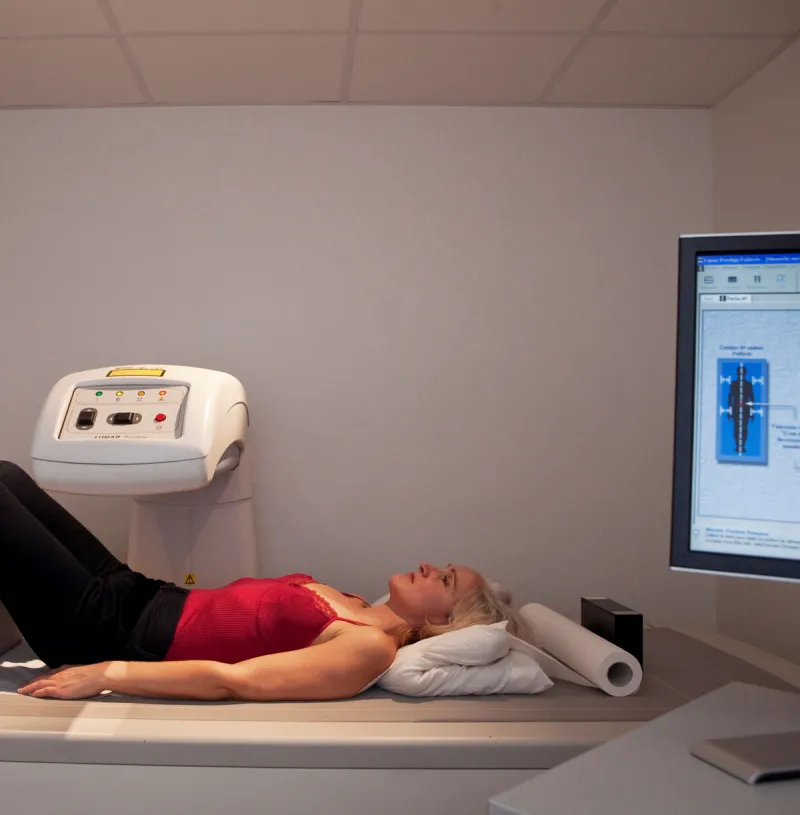
Photo: mature Canadian woman bone health DEXA scan osteoporosis medical consultation, via www.menopausehealth.co.uk
Somewhere between a routine bone density scan and a prescription for bisphosphonates, many Canadian women over 50 encounter an uncomfortable truth: the treatments their physicians offer are largely designed to slow a process, not reverse it. Osteoporosis — the progressive loss of bone mineral density that affects an estimated two million Canadians, the majority of them women — has long been managed rather than meaningfully treated. That distinction is beginning to matter enormously to a generation of women who refuse to accept skeletal fragility as an inevitable feature of ageing.
At Stem Cell Jamaica, we have observed a steady and significant increase in Canadian women arriving not in crisis, but in anticipation — seeking regenerative interventions before osteoporosis advances to the point where fracture risk becomes the dominant clinical concern. Their journeys, and the science that supports them, illuminate a compelling case for rethinking what bone health treatment can accomplish.
The Cellular Architecture of Bone Loss
To understand why stem cell therapy holds genuine promise for osteoporosis, it helps to understand what is actually happening inside ageing bone tissue. Bone is a living organ, continuously remodelled through a carefully balanced process involving two principal cell types: osteoblasts, which synthesise new bone matrix, and osteoclasts, which break down old or damaged bone. In younger bodies, this cycle maintains skeletal integrity with remarkable efficiency.
After menopause, the withdrawal of oestrogen disrupts this balance profoundly. Osteoclast activity accelerates while osteoblast function diminishes, creating a net deficit in bone mass year after year. Trabecular bone — the porous, lattice-like structure found in vertebrae and the ends of long bones — is particularly vulnerable. The result is a skeleton that appears intact on the surface but has been hollowed of its structural resilience.
Mesenchymal stem cells (MSCs), found naturally in bone marrow and adipose tissue, are the precursors from which osteoblasts are derived. As women age, the number and regenerative capacity of these stem cells decline. Regenerative medicine intervenes at precisely this point: by introducing concentrated populations of MSCs — either harvested from the patient's own tissue or from ethically sourced donor material — clinicians aim to restore the osteoblast pool and reactivate the bone formation side of the remodelling equation.
Why Conventional Treatments Fall Short for Many Women
Bisphosphonates such as alendronate and risedronate remain the first-line pharmacological response to osteoporosis in Canada. These medications work by inhibiting osteoclast activity — essentially suppressing bone breakdown. While they can reduce fracture risk in the short to medium term, they do not stimulate new bone formation. Over extended use, they have been associated with a paradoxical increase in a rare but serious complication known as atypical femoral fracture, as well as osteonecrosis of the jaw in a subset of patients.
Hormone replacement therapy (HRT) offers oestrogen-mediated protection against bone loss for some women, but it carries its own profile of risks — including associations with certain cancers and cardiovascular events — that make it unsuitable or undesirable for a significant proportion of the population.
For women who are deeply invested in an active lifestyle, who carry genetic predispositions toward osteoporosis, or who have already experienced adverse effects from pharmaceutical management, the limitations of conventional care become personal and pressing. It is this group — informed, motivated, and unwilling to simply manage decline — that is increasingly finding its way to regenerative medicine.
What Canadian Women Are Experiencing in Jamaica
Patients who travel from Canada to seek treatment at regenerative medicine clinics in Jamaica typically arrive with documentation of their bone density trajectory: serial DEXA scans showing T-scores in the osteopenic or osteoporotic range, sometimes alongside bloodwork reflecting elevated bone resorption markers such as serum CTX or urinary NTX. These objective measurements provide the baseline against which treatment outcomes are assessed.
One patient from British Columbia, a retired physiotherapist in her early sixties, described her experience candidly. Having watched her T-score deteriorate steadily over six years despite bisphosphonate therapy, she sought consultation with a regenerative medicine specialist and ultimately underwent a course of MSC therapy in Jamaica. Follow-up DEXA imaging conducted in Vancouver twelve months later showed a modest but measurable improvement in lumbar spine bone density — a reversal, however incremental, of a trend that had previously moved in only one direction.
Another patient, a 57-year-old educator from Ontario with a strong family history of osteoporosis and a documented intolerance to bisphosphonates, described the decision to pursue treatment in Jamaica as one she had researched exhaustively before committing to. "I needed to understand the mechanism," she explained, "not just hear that it had worked for someone else." Her post-treatment markers reflected a reduction in bone resorption activity alongside early indicators of improved bone formation — a dual signal that conventional therapy rarely produces.
These are individual accounts, and they should be understood as such. Regenerative medicine for osteoporosis is not a guaranteed cure, and outcomes vary according to the degree of existing bone loss, the patient's overall health status, and the specific protocols employed. What these cases illustrate, however, is that for carefully selected patients, MSC-based therapy may accomplish something pharmacological management cannot: stimulation of the bone-forming process itself.
The Jamaica Advantage: Specialisation Without the Wait
Canada's public healthcare system, while comprehensive in many respects, is not structured to accommodate emerging regenerative therapies that have not yet completed the full regulatory approval pathway. Canadian women who wish to explore MSC therapy for osteoporosis face a system that offers neither access nor guidance within its standard framework. Private clinics operating in Canada are limited in scope, and the regulatory environment constrains what can be offered.
Jamaica's medical landscape presents a different set of conditions. Regenerative medicine clinics operating in Jamaica benefit from a regulatory framework that permits the clinical application of MSC therapies under appropriate medical supervision, enabling the delivery of treatments that remain inaccessible within the Canadian system. The proximity — a direct flight from Toronto to Kingston takes under four hours — reduces the logistical burden considerably compared with seeking care in Europe or Asia.
For Canadian women who have built their careers, raised families, and maintained active lives with considerable discipline, the prospect of a fracture — a vertebral compression, a hip break, a Colles fracture from a simple fall — is not abstract. It is a concrete threat to the independence they have worked to preserve. The willingness to travel for a treatment that addresses that threat at the cellular level reflects not desperation, but a clear-eyed assessment of their options.
A Conversation Worth Having
None of this is to suggest that stem cell therapy should replace the foundational elements of bone health management: adequate calcium and vitamin D intake, resistance training, fall prevention strategies, and regular monitoring. These remain essential, and any responsible regenerative medicine programme incorporates them as complementary pillars.
What is changing is the ceiling on what treatment can achieve. For Canadian women over 50 who have watched the standard pharmaceutical toolkit fail to restore what time and hormonal change have taken, regenerative medicine offers a scientifically grounded alternative worth serious consideration. The conversation is no longer speculative — it is clinical, it is documented, and it is happening with increasing frequency in the consultation rooms of Jamaica's regenerative medicine specialists.
If you are a Canadian woman navigating osteoporosis and seeking to understand whether stem cell therapy may be appropriate for your specific situation, Stem Cell Jamaica welcomes your enquiry. Our clinical team is available to review your diagnostic history and provide an honest assessment of what regenerative medicine can and cannot offer in your case.